antigravity-cloud-run
For coding agents, real-time collaboration beats the “wisdom of the crowd”
tl;dr: I ran AI coding agents on 30 Project Euler problems in two ways: five agents working separately, and five agents collaborating in real time. For both, I also computed the majority vote across the five answers at the end. The collaborating agents beat both the separate agents and their majority vote. Average accuracy without the vote went from 72% to 87%.
The setup
I had AI coding agents, specifically Gemini 3.5 Flash running through Antigravity, tackle 30 math and programming problems from Project Euler: all problems published this year except one (983), whose answer I could not verify on the website.
For each problem, five agents ran in five concurrent containers. I ran them in two ways:
- Solo: no ability to communicate with each other as they solved the problem.
- Collaborative: extra prompts letting them know they can collaborate, and an MCP server that lets any agent broadcast a message to the rest, kind of like sending each other emails.
In both cases I also took the majority vote across the five answers at the end. So in total there are four methods to compare: solo individuals, solo with vote, collaborative individuals, and collaborative with vote.
Each agent had 30 minutes of working time, plus up to 10 extra minutes to wrap up and submit a final answer, so a single run can take up to about 40 minutes.
The results
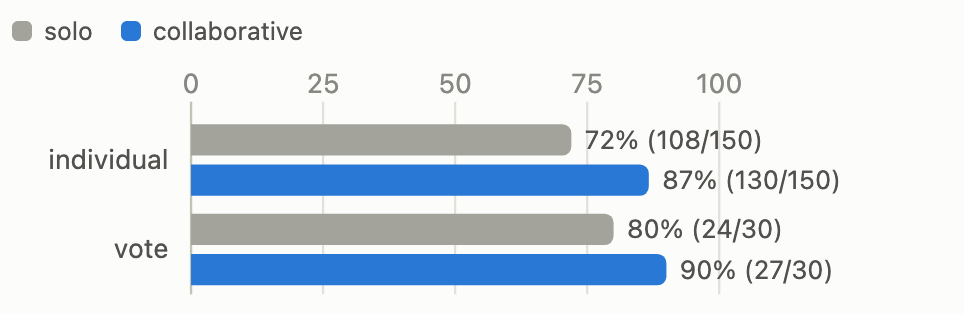
Individually, solo agents got 108 of 150 runs correct (72%). With real-time collaboration, the same setup got 130 of 150 (87%). The majority vote went from 24 of 30 problems (80%) to 27 of 30 (90%). As you can see, both real-time collaboration and the “wisdom of the crowd”, aka majority voting, are effective, but real-time collaboration had a stronger effect on the overall accuracy.
| solo | collaborative | |
|---|---|---|
| average run time | 14m | 10m |
| median worst-of-5 time | 31m | 11m |
The worst-of-5 time is relevant because if you wait for all five answers, that is when you get the final answer through the vote. The average time is relevant in a different way: it is a proxy for measuring the tokens and compute you use. Antigravity unfortunately does not give you exact token counts, but tokens and compute scale with the time it takes to solve a problem.
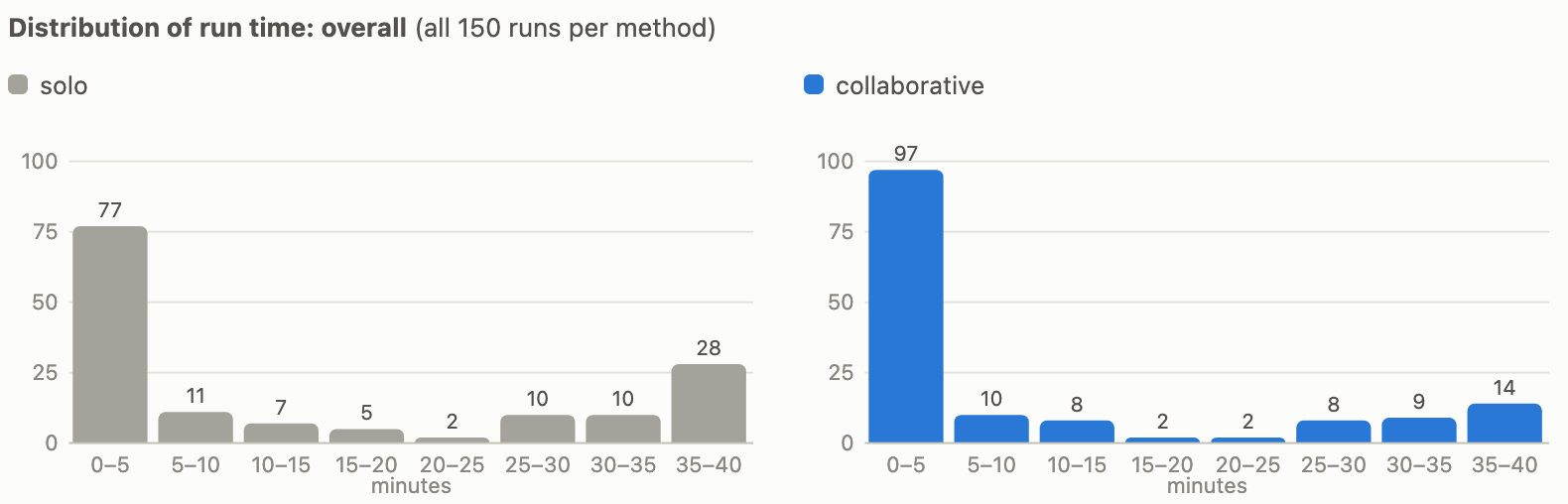
More collaborative runs end inside the first five minutes (97 vs 77), and fewer of them run past the 30 minute mark (23 vs 38).
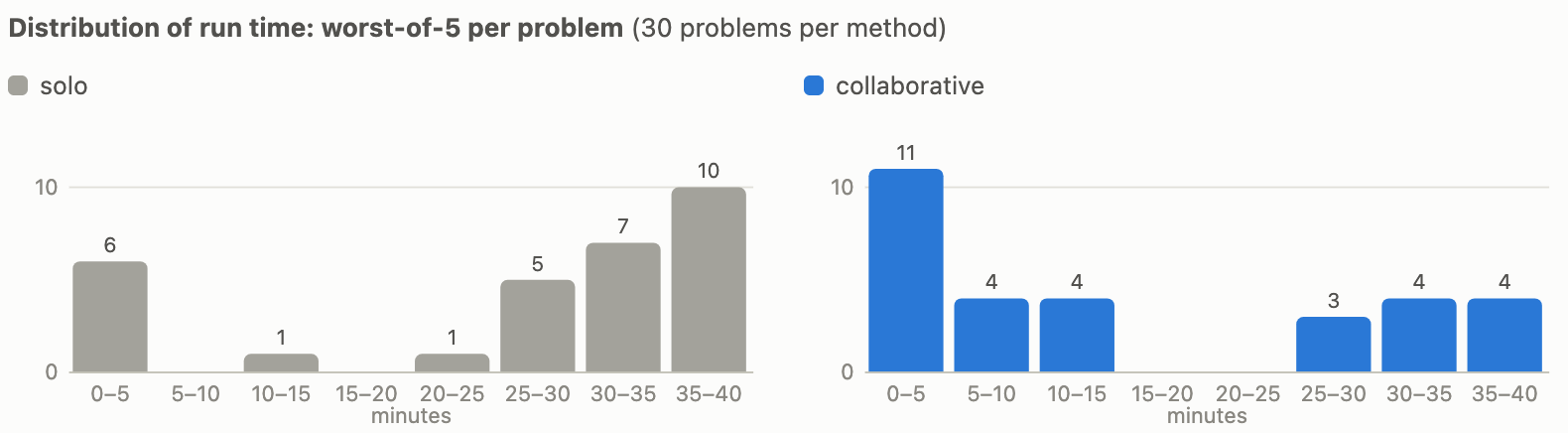
On worst-of-5 time, solo sets pile up at the 30 to 40 minute end because many problems left at least one agent running until the cap. Collaborative sets most often finish within the first five minutes because once one agent solves the problem and shares its findings, the rest can finish quickly too, though the harder ones still run long.
Three individual problems are worth calling out:
- The rescue. On problem 989, solo agents went 0 for 5, and two of them submitted confident wrong answers. In the collaborative run, one agent shared a verified characterization of the problem’s structure at minute 5, two others confirmed intermediate values against an example given in the problem statement, and all five agents converged on the correct answer, unanimously. Collaboration solved a problem that no individual agent solved in any run.
- The speedup. On problem 993, solo went 3 of 5 with one agent falling into a subtle extrapolation trap. The collaborative run went 5 of 5, about 4 times faster.
- The failure. On problem 1006, nobody solved it in either setup. But in the collaborative run, a correctly verified intermediate value circulated between agents, and two of them submitted it as the final answer.
Disclaimers
These agents are not deterministic. If you try to reproduce the results you might get slightly different numbers, but in principle you should be able to get similar results.
Per Project Euler’s rules, no numeric answers are published here or in the repo. Runs were scored against privately held answers that were verified on the site itself.
Open questions
The insights here were drawn from experiments with only 5 agents, so there are still many unknowns.
- What about 25 agents, 50, 100? Does it scale to solving harder and harder problems?
- With 100 agents, is it better to have one big group chat, or ten separate group chats of ten, with some way to communicate between the groups as well?
- Does it work as well with other models?
- Does it work with other harnesses?
- Is it better to let them collaborate freely as we did here, or assign them specific roles?
A lot of open questions, but I believe this is a decent start.
Prior art
One of the closest things currently in production is xAI’s Grok Heavy line: Grok 4 Heavy ran multiple agents in parallel that compare notes like a study group, and the newer versions make a multi-agent setup the default for complex queries.
Appendix
The exact prompts, the Dockerfile, and the full per-run outcome data (correct or not, and time taken, for all 300 runs) are in the appendix.