Awesome Agents on Google Cloud
Session backend benchmarks
How much time ADK session storage adds, compared across three backends through
the same SessionService interface.
What was tested
bench_session_backends.py times the two paths a chat app takes, five rounds each:
- New conversation:
create_session(the first create in a fresh process is reported separately - that’s the slow one) - Continuing turn:
get_session+append_event(one turn’s session work)
Backends: InMemorySessionService, DatabaseSessionService on local SQLite,
DatabaseSessionService on Cloud SQL (Postgres 16, smallest tier, us-central1,
reached through the Cloud SQL Auth Proxy), and VertexAiSessionService
(Agent Engine Sessions). No model is involved anywhere.
Results (2026-08-14, from a Cloud Run job container in us-central1)
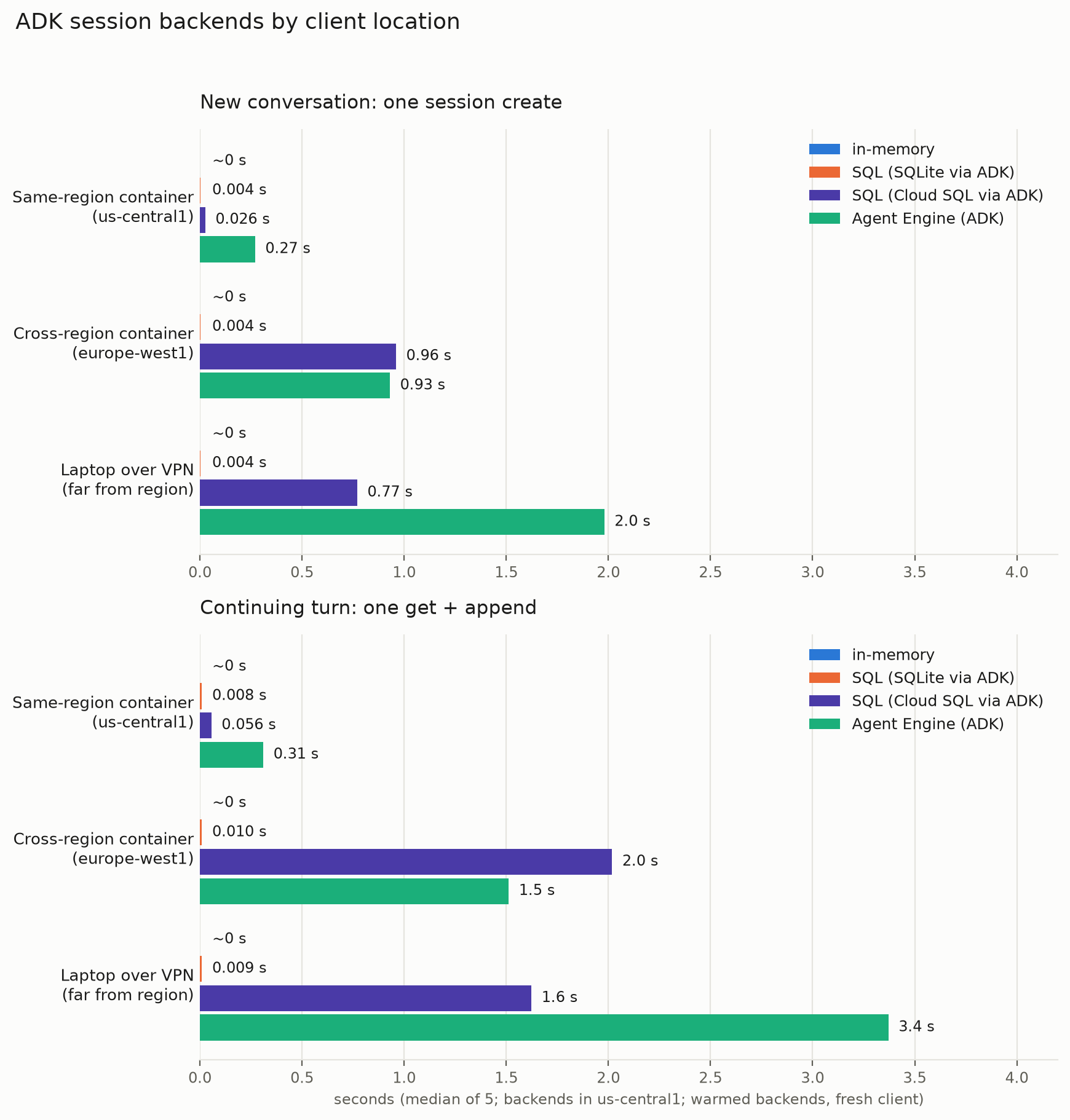
The fair setup: all four backends timed from the same container in the backends’ own region, schema and engine pre-created by an untimed warmup, then measured through a brand-new client. Medians of 5 operations; three job executions.
| Backend | New (first in process) | New (later) | Continuing turn |
|---|---|---|---|
| in-memory | ~0 s | ~0 s | ~0 s |
| SQL (SQLite via ADK) | 0.016 s | 0.004 s | 0.008 s |
| SQL (Cloud SQL via ADK) | 0.27 s (first connection) | 0.026 s | 0.056 s |
| Agent Engine (ADK) | 0.25 s | 0.27 s | 0.31 s |
The same job deployed to europe-west1, talking to the same us-central1 backends (cross-region, still no proxy):
| Backend | New (first in process) | New (later) | Continuing turn |
|---|---|---|---|
| SQL (Cloud SQL via ADK) | 7.4 s (first connection) | 0.96 s | 2.0 s |
| Agent Engine (ADK) | 0.96 s | 0.93 s | 1.5 s |
Notes:
- google-adk 2.6.3 (the version the app ran) and 2.7.0 measured the same.
- The first-ever execution saw 1.4 s Agent Engine creates once; later executions settled at ~0.25 s.
- Colocation matters most for SQL: a SQL operation is several database round-trips, so Cloud SQL goes from 19x faster than Agent Engine (same region) to slightly slower (cross-region). Its cross-region first connection is also expensive (7.4 s, consistent across runs).
- From a Mac far outside the region over a VPN, everything took seconds (Agent Engine ~2-3.5 s per op, Cloud SQL 0.8-1.6 s through the Auth Proxy), and 15 s+ first creates were observed on 2026-08-12. Those extremes did not reproduce in any fair setup.
- Cloud SQL = smallest Postgres 16 tier, reached over Cloud Run’s built-in connection (no proxy process). ADK’s one-time schema creation on a fresh database is excluded by the warmup, as production would never pay it per process.
bench_sessions.py is the earlier, finer-grained script: it times each operation
individually and ends with a raw-REST probe of the same read (~0.16 s), which is
what showed the overhead lives in the client path rather than the API.
Run it
cd app && GOOGLE_CLOUD_PROJECT=<project> AGENT_ENGINE_ID=<engine id> \
  SQL_DB_URL=postgresql+asyncpg://postgres:<password>@127.0.0.1:5433/postgres \
  uv run --with-requirements requirements.txt \
  --with sqlalchemy --with aiosqlite --with asyncpg \
  python ../test/bench_session_backends.py
The engine can be an empty Agent Engine resource - nothing deploys to it. The
Cloud SQL URL points at a local Cloud SQL Auth Proxy (or, in a Cloud Run job,
the built-in /cloudsql/... socket). Both cloud env vars are optional: without
them the local backends still run. For the fair in-region numbers, run the same
script as a Cloud Run job in the backends’ region.
Other files here
smoke.sh- acceptance suite for the deployed app;testing.mdexplains all the test layers.cold.sh- cold-boot timing for the GPU box.